




20+healthy volunteers
First study
It compared the SiXDEVICE programme with a traditional visual training programme. After four weeks, responses in the SiXDEVICE group were faster and more accurate, with less use of attentional resources.
performance in the static balance test

often they share a single cause
Your eyes don't work on their own. When your attention stays fixed for hours, your body compensates: your neck, jaw and breathing stiffen. You can chase each discomfort with a remedy, or understand how you work and manage it yourself.
omissions in the Stroop attention task
perceived reading fluency
perceived fatigue when reading a passage
reported mental fatigue
These items come from the questionnaire we use in our assessments. They are different ways in which the same compensation shows itself, and they are not usually linked to one another. Do you recognise more than two?
Everything else is left in the background. That is why we forget to drink and don't notice when someone walks into the room.
These are strategies we use to finish what we are doing. They only become a problem when they go on for years and the system no longer gets the chance to find its way back on its own.

Marco Grassi, optometrist, third generation of a family that has worked in optics for over a century. Since 1997 he has designed and made instruments for functional vision re-education, distributed in Europe and the United States and used in university laboratories in Italy, the rest of Europe, the United States and Hong Kong.
Find out more about meIf reading the same line several times has become normal
Learn moreIf the tiredness doesn't go away when you switch off
Learn moreIf the same discomforts keep coming back
Learn moreIf your movements don't flow
Learn moreIf you move more cautiously than you would like
Learn moreSupport that works alongside specialists
Learn moreMost approaches start from the idea that a weak function needs to be trained, with exercises to repeat. Armonia Visiva starts from a different idea: when a system is free to reorganise, it does so on its own, because it already has everything it needs.
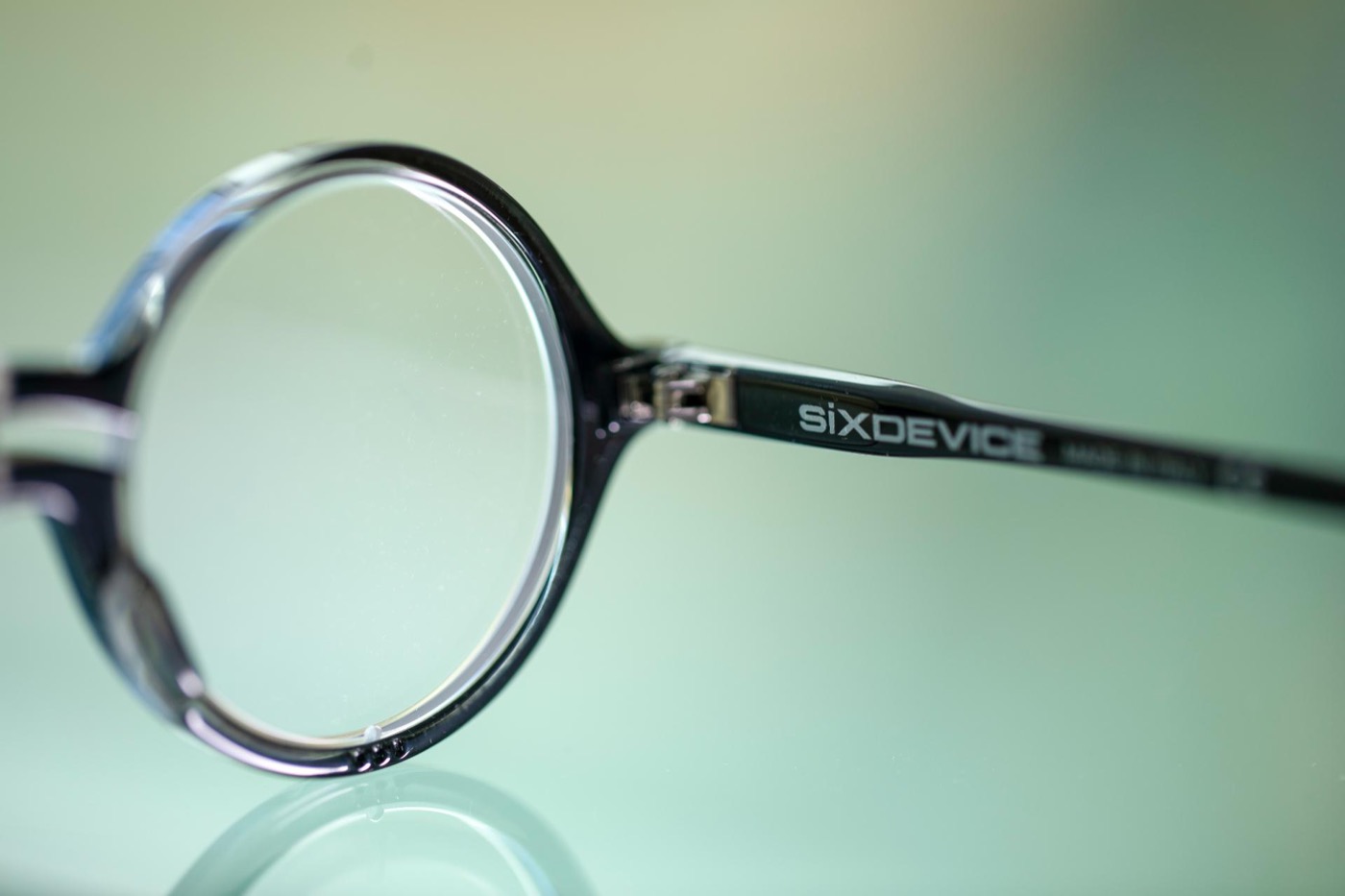
Our work is to remove the obstacle. The device we use, SiXDEVICE, is an optical device with centesimal prismatic lenses. It does not correct your sight and does not magnify: it modulates the quality of the visual information reaching the system, so that the system can reorganise on its own. You wear it during your normal daily activities, whatever they are: studying, reading, working at the computer, training.
The goal is not to make you feel better while you wear it. It is to make you aware of how you work: which situations demand the most from you, which signals appear first, what changes when the system is free.
Discover SiXDEVICE
Some changes are reported more often than others at follow-up assessments. They do not all arrive at once or in the same order: which ones come first depends on where your body is working hardest.
Freer neck and jaw, less tense shoulders, fuller breathing
More fluent reading, less need to reread the same line
Balance and orientation in space, even in crowded places
Less tiredness at the end of the day, more restful sleep
Visual quality that holds up as the hours go by, even at the screen

The assessment does not measure how many lines you can read on the chart. It observes how your system organises itself: freedom of movement, your relationship with space, how much effort it takes you to keep your attention.
We start from your situation and what you want to improve, with an individual timeline and approach, not a one-size-fits-all protocol.
The method includes follow-up assessments to check the changes and tailor the programme, up to the maintenance phase.
Since 2019 the method has been studied together with the International Research Center for Cognitive Applied Neuroscience and the Department of Psychology of Università Cattolica del Sacro Cuore in Milan, coordinated by Professor Michela Balconi.
Read the studiesIt compared the SiXDEVICE programme with a traditional visual training programme. After four weeks, responses in the SiXDEVICE group were faster and more accurate, with less use of attentional resources.
At the end of the four weeks, a reduction in mental fatigue reported by participants was observed, along with an improvement in attention and balance tests.
The questionnaire we use in our assessments is available online. It is not a test and does not give a diagnosis: it shows you which of your discomforts belong to the same system. At the end you receive personalised feedback.
Because visual fatigue does not depend on sharpness, but on how much work the system does to maintain it. An eye test measures how sharply you see while standing still. It does not measure how much energy you use to keep that sharpness for eight hours while you move, read and think.
It is not your gaze that stays fixed, but your attention. When it stays focused on a narrow area for a long time, the system works harder to process information, and your neck, jaw and breathing stiffen around that position. It is the processing that tires you: the discomfort appears where the body has compensated, not where the problem started.
Yes. The device works on the quality of visual information, not on sharpness, so it works with or without correction. It does not replace your glasses and does not change your prescription.
SiXDEVICE is a Class I medical device registered with the Italian Ministry of Health, but the programme is not a therapy. It does not diagnose, does not treat medical conditions and does not replace any healthcare pathway. It is a consultancy programme that aims to make each person independent in managing their own efficiency.
It makes it easier to relate to space and improves response times, precision and the execution of the movements involved in dancing, playing musical instruments and managing diaphragmatic freedom in singing.
It supports functional or structural work under way or planned with other professionals, such as combined use with bite splints, orthodontic appliances, palatal expanders, sensory activators and insoles.
If you have a question before you start, or would rather tell us about your situation, write to us.
We will reply to the email address you gave us.